
28 August 2007


02 August 2007
Golf: day 1

The morning started off damp and soggy, but improved to become a crisp sunny day. My game started crisp and went soggy. Two rounds in the bag.
01 August 2007
Halfway there
I'm halfway done and I've made two observations:
- Blogger seems to perform IP based i18n
- Windows CE is shit (ok fine- I didn't need to go halfway around the world to figure this one)
I'm in Frankfurt, or more specifically the Frankfurt airport. It doesn't have free wireless internet access. Neither did Chicago. But both had T-Mobile deals. But then my Chicago T-Mobile account didn't seem to take in Frankfurt. Anyway, whatever. Here's the fun part:

Our friends here (in the context of the site you are reading) seem to have a mechanism to convert my IP address into a geographical location. In turn, they've defaulted my language/locale over automatically. Nifty. But after a few minutes of thinking, perhaps a little irritating too. Really- the last time I was at the site, I did everything in English, so why the switcheroo? It wasn't like I was an anonymous user either.. Anyway, +1 on pulling the IP based i18n.
Bullet point number two (the Windows CE being given excrement status), is evidenced by this, in mid-flight (and more irritatingly, mid-movie):

Needless to say, the powers that be at MS were looking down upon me since my particular console (embedded into the back of the seat in front of me) took about a thousand times longer to start than any of the other ones of the plane.
18 July 2007
java final vars != magic constant creator
In general, a lot of us tend to use the final keyword alongside public and static. Quite often too, we use it to declare a constant, perhaps a String, or int value. But, does the final keyword cause the variable to become a constant?
Alright. We've got a constant. Let's try and make it not so constant:
So the compiler enforces that you can't try to assign a value to a final variable. It didn't say anything about keeping it constant (that was the variable name). So, let's try and switch this up:
This compiles and runs fine with the output as above. Let's try and break this.
So, we just changed a final declared variable. Ok, let's try and change it a little differently.
So, what gives?
public class FinalExample {

  public static final String CONSTANT =
   "I can never change!";

}
Alright. We've got a constant. Let's try and make it not so constant:
public class FinalExample {

  public static final String CONSTANT =
   "I can never change!";

  public static void main (String[] args) {
    CONSTANT = "I can always change";
  }

}

$ javac *.java
FinalExample.java:7: cannot assign a value to final variable CONSTANT
    CONSTANT = "I can always change";
    ^
1 error
So the compiler enforces that you can't try to assign a value to a final variable. It didn't say anything about keeping it constant (that was the variable name). So, let's try and switch this up:
public class FinalExample {

  public static final String[] CONSTANT_ARRAY =
   {"I", "can", "never", "change"};

  public static void main (String[] args) {
    for (int x=0; x<CONSTANT_ARRAY.length; x++)
      System.out.print(CONSTANT_ARRAY[x] + " ");
    System.out.println();
  }

}

$ java FinalExample
I can never change
This compiles and runs fine with the output as above. Let's try and break this.
public class FinalExample {

  public static final String[] CONSTANT_ARRAY =
   {"I", "can", "never", "change"};

  public static void main (String[] args) {
    CONSTANT_ARRAY[2] = "always";
    for (int x=0; x<CONSTANT_ARRAY.length; x++)
      System.out.print(CONSTANT_ARRAY[x] + " ");
    System.out.println();
  }

}

$ java FinalExample
I can always change
So, we just changed a final declared variable. Ok, let's try and change it a little differently.
public class FinalExample {

  public static final String[] CONSTANT_ARRAY =
   {"I", "can", "never", "change"};

  public static void main (String[] args) {
    CONSTANT_ARRAY =
   {"I", "can", "always", "change"};
  }

}

$ javac *.java
FinalExample.java:6: illegal start of expression
    CONSTANT_ARRAY = {"I", "can", "always", "change"};
                     ^
1 error
So, what gives?
- Final declarations ensure that a declared variable is never re-assigned to something else. Once you go: final something = something, you don't get to say something = something_else later on.
- In the event that your object is mutable- ie: can be changed, you are out of luck in trying to make it a constant using final. So, something like a Calendar object which has setters on it to change its value won't hold some magical constantness by being declared as final. This applies to array elements too, as demonstrated above.
15 May 2007
The Gentoo experiment
Podunk said:
My experiment with Gentoo is complete. As it so happens, a coworker got the same hardware that I did, at the same time. He installed Ubuntu 7.04. It turns out that the compile times, and some other benchmarks really were around 0.1% (if that at times) between the two different installs.
I know a learned a huge amount of information about how a Linux install works under the hood. Much props to any Linux distro that moves you through it painlessly. There was also some strange fascination that I derived in watching source get downloaded and compiled so effortlessly. Perhaps its that same feeling you got when you used to see a kernel compile; you're really not that smart- you didn't write the code after all, but compiling it sure feels cool- especially when the screen is dumping debug like there's no tomorrow.
But, back to the point- why is it that there's no real performance difference between an Ubuntu and a Gentoo- one compiled for my machine, and another based off pre-compiled binaries? Maybe that's the beauty of the operating system. Maybe I'm just an ass. I don't know.
I do know this- I like my Debain based distros, and I've switched back to one.
<arnold>Gentoo iss fo getting you pumped uuuup!<arnold>
Well, that an for agonizing over which CFLAGS to use to make programs that already complete in milliseconds do so 3% faster.
My experiment with Gentoo is complete. As it so happens, a coworker got the same hardware that I did, at the same time. He installed Ubuntu 7.04. It turns out that the compile times, and some other benchmarks really were around 0.1% (if that at times) between the two different installs.
I know a learned a huge amount of information about how a Linux install works under the hood. Much props to any Linux distro that moves you through it painlessly. There was also some strange fascination that I derived in watching source get downloaded and compiled so effortlessly. Perhaps its that same feeling you got when you used to see a kernel compile; you're really not that smart- you didn't write the code after all, but compiling it sure feels cool- especially when the screen is dumping debug like there's no tomorrow.
But, back to the point- why is it that there's no real performance difference between an Ubuntu and a Gentoo- one compiled for my machine, and another based off pre-compiled binaries? Maybe that's the beauty of the operating system. Maybe I'm just an ass. I don't know.
I do know this- I like my Debain based distros, and I've switched back to one.
apt-get install happiness
07 May 2007
Idiots
How can it be so difficult to legally buy a song online?
Here's the challenge- find a service to download a song. It has to be adhere to the following standards:
- Encoded in a standard format (no iTunes m4p), and works on a music player (xmms/vlc/banshee), so music should be a legit (read: standard) sound format
- Doesn't need an application to interface with the service. (Haven't we been using a browser to search/sort/browse/download fairly well?)
- Gives me the same flexibility as a CD would: I can back it up, rip to my computer, make copies for my use.
After a day or two of fruitless searching, I found a couple of candidates: mp3tunes, and maybe emusic. But, both seem to be indie-label oriented.
Maybe I'm missing something obvious here, and there really is an easy way to do what I want to do: get music legally without being encumbered by some third party software. At the moment, the only viable avenues I seem to have are:
- hit the P2P clouds and "acquire" my music
- buy a CD and be legal, but land up paying extra for tracks I don't want
I'm not going to hit the P2P could (I have a wife and dog to think about), but perhaps it answers why so many people do lean that way. I know I'd gladly pay a buck a song if I could get it on my terms- but alas, that seems impossible at the moment.
Perhaps the RIAA won't issue a license to someone that wants to provide music in a fairly open way. Perhaps no one has thought of that yet? Is it illegal? I don't know. Have you had better luck finding music online?
17 April 2007
Free internationalized text in Java
The Locale object is absolutely phenomenal. It packs so much, for so little. If you've ever worked with any internationalized app, you know how hard it can be to get things translated and then figure out how to reference it later. Well, you can get a lot of stuff for free with Java. Take the snippet below for example.
Now, take a look at the output (trimmed):
We just got a huge amount of stuff for free! Check it out:
Sure- the Locale object is programmed to do this. It should behave like so. But the translations are there too, and you get them on the house. If you look at Locale closely, you can even use it to get language and country names, in other Locales, thereby allowing you to generate a list of languages, with each language in the language it is in. Really helpful when you want to try and present a language or country selection.
|
Now, take a look at the output (trimmed):
ar  Arabic 17 أبريل, 2007
iw_IL Israel Hebrew יום שלישי 17 אפריל 2007
ja_JP Japan Japanese 2007年4月17日
ko  Korean 2007년 4월 17일 화요일
de_LU Luxembourg German Dienstag, 17. April 2007
el  Greek Τρίτη, 17 Απρίλιος 2007
en_IE Ireland English 17 April 2007
en_IN India English Tuesday, 17 April, 2007
mk  Macedonian вторник, 17, април 2007
tr_TR Turkey Turkish 17 Nisan 2007 Salı
uk  Ukrainian вівторок, 17, квітня 2007
en  English Tuesday, April 17, 2007
We just got a huge amount of stuff for free! Check it out:
- translated, in language names for things like the day and month names
- separators (commas switch to periods) by Locale
- Ordering of elements in a Locale sensitive manner
Sure- the Locale object is programmed to do this. It should behave like so. But the translations are there too, and you get them on the house. If you look at Locale closely, you can even use it to get language and country names, in other Locales, thereby allowing you to generate a list of languages, with each language in the language it is in. Really helpful when you want to try and present a language or country selection.
16 April 2007
A new favorite: Gentoo
The folks at work delivered a spanking new machine to me about a week ago. A dual-dual-core Xeon. It looks a little like a mini-refrigerator. Pohl once posed a question to me after I had finished building my dream rig some four years back: "So, what operating system do you intend to run all that nice hardware with?"
My new rule is not to get comfortable. Ubuntu had become too easy. And mind-numbing: I didn't know what was going on under the hood any more, or I didn't have to worry about it. But isn't that half the fun?
I downloaded the Gentoo 2006.1 CD, and peeked at the excellent installation documentation. Even if you aren't going to install Gentoo, but want a good reference on what a Linux installation does, this is a fantastic resource. Going through the installation is like a practical exercise in understanding a lot of basics. The documentation even has links to further reading.
The biggest hurdle I encountered was trying to get my new kernel to boot. The problem turned out to be a non-issue. I didn't realize that the box was equipped with Serial Attached SCSI, and assumed that the disks were attached to a regular SATA-2 port. With that figured out, things went real smooth. The last time I had built a kernel must have been on 2.4.x, but with the 2.6.x builds, the process is really much simpler.
The package management system on Gentoo, Portage is about as simple to use as the APT system. Except, that you get to configure what your builds compile in via a make.conf file that provides explicit flags on library support you want or not. I've eschewed gnome, and found XFCE to be a comfortable, light environment that really does everything that Gnome did for me, with a little more ease, and quicker. Really- when was the last time that the wireless-networking applet worked better then a couple of iwconfig calls?
Oh, and then I accidentally stumbled on a fancy little music player called waif. Dubbed the "Console Audio Unfrontend", it approaches the concept of an audio player without the need for a front-end at all. Needless to say, I'm hooked.
My new rule is not to get comfortable. Ubuntu had become too easy. And mind-numbing: I didn't know what was going on under the hood any more, or I didn't have to worry about it. But isn't that half the fun?
I downloaded the Gentoo 2006.1 CD, and peeked at the excellent installation documentation. Even if you aren't going to install Gentoo, but want a good reference on what a Linux installation does, this is a fantastic resource. Going through the installation is like a practical exercise in understanding a lot of basics. The documentation even has links to further reading.
The biggest hurdle I encountered was trying to get my new kernel to boot. The problem turned out to be a non-issue. I didn't realize that the box was equipped with Serial Attached SCSI, and assumed that the disks were attached to a regular SATA-2 port. With that figured out, things went real smooth. The last time I had built a kernel must have been on 2.4.x, but with the 2.6.x builds, the process is really much simpler.
The package management system on Gentoo, Portage is about as simple to use as the APT system. Except, that you get to configure what your builds compile in via a make.conf file that provides explicit flags on library support you want or not. I've eschewed gnome, and found XFCE to be a comfortable, light environment that really does everything that Gnome did for me, with a little more ease, and quicker. Really- when was the last time that the wireless-networking applet worked better then a couple of iwconfig calls?
Oh, and then I accidentally stumbled on a fancy little music player called waif. Dubbed the "Console Audio Unfrontend", it approaches the concept of an audio player without the need for a front-end at all. Needless to say, I'm hooked.
09 March 2007
mini ExecutorService & Future how-to for Java 5
I'd been meaning to get a little example that scrapes the surface of the java.util.concurrent package online. Here's what I came up with:
import java.util.concurrent.*;
import java.util.*;

public class Example implements Runnable {

  private static Random random = new Random();

  private String payload;

  public Example (String someString) {
    this.payload = someString;
  }

  public String getPayload() {
    return this.payload;
  }

  public void run () {
    int seconds = random.nextInt(10);
    long totalSleep = 1000l*seconds;
    try {
      Thread.sleep(totalSleep);
    } catch (InterruptedException tie) {
      throw new RuntimeException("I got interrupted");
    }
    System.out.println(this.payload);
  }

  public static void main (String[] args) {
    ExecutorService es = Executors.newFixedThreadPool(3);
    List<Future<Example>> tasks = new ArrayList<Future<Example>>();
    for (int x=0; x<10; x++) {
      String name = "I am thread number: " + x;
      Example e = new Example(name);
      Future<Example> future = es.submit(e, e);
      tasks.add(future);
    }
    // -- all threads should be launching, let's get the Example objects
    try {
      for (Future<Example> future : tasks) {
        Example e = future.get();
        System.out.println(" [future complete]: " + e.getPayload());
      }
      es.shutdown();
    } catch (ExecutionException e) {
      throw new RuntimeException(e);
    } catch (InterruptedException ie) {
      throw new RuntimeException(ie);
    }
  }

}
It's a very simple thread. It gets constructed with a String (payload). When run, it sleeps for an arbitrary amount of time (less than 10 seconds), and then prints out the payload it was constructed with.
There's really nothing new with the Runnable interface and the run method here. The fun part is what we get to play with from the java.util.concurrent package.
The first major point to note is that we aren't going to launch Threads the old-fashioned way [Thread t = new Thread(someRunnable); t.start();]. Instead, we're going to create an ExecutorService and submit our Runnable objects to it. There are a variety of ExecutorService implementations that can be created from the Executors factory, but the simplest of the lot might be the one created by the newFixedThreadPool(int size) method. The method name in this case is fairly self-documenting.
public static void main (String[] args) {
  ExecutorService es = Executors.newFixedThreadPool(3);
The next fancy object that we encounter is Future. The ExecutorService's submit method can accept a Runnable as well as an arbitrary object, in this case, an Example. In return, it will provide a Future<Example>. (Note that in our case, even though we are submitting the same instance variable (e), it is treated as a Runnable, and then an Example in the context of the submit method). We've also got a List of Future of Examples that we augment with our freshly returned Future<Example> object.
List<Future<Example>> tasks = new ArrayList<Future<Example>>();
for (int x=0; x<10; x++) {
  String name = "I am thread number: " + x;
  Example e = new Example(name);
  Future<Example> future = es.submit(e, e);
  tasks.add(future);
}
At this point, the ExecutorService has already begun to start all the Runnables it can (3 concurrently in this case). As soon as one completes, it will replace it with another. However, all of that action is happening in a separate thread, and our main method proceeds execution. And our main method is still chugging along, which gets us here:
try {
  for (Future<Example> future : tasks) {
    Example e = future.get();
    System.out.println(" [future complete]: " + e.getPayload());
  }
  es.shutdown();
} catch (ExecutionException e) {
  throw new RuntimeException(e);
} catch (InterruptedException ie) {
  throw new RuntimeException(ie);
}
We loop over the list, and recover the Future<Example> objects that we threw in there as a result of the Runnable submissions. Note that we're doing this in the same order as we created and submitted our threads to the pool. We then get() the Example object that we asked the ExecutorService to return to us upon thread completion. As you can see, the Future is the conduit for this activity. Finally, we shutdown the pool.
Here's the output from the execution:
~/Code/concurrency keerat$ java Example
I am thread number: 1
I am thread number: 2
I am thread number: 4
I am thread number: 0
 [future complete]: I am thread number: 0
 [future complete]: I am thread number: 1
 [future complete]: I am thread number: 2
I am thread number: 5
I am thread number: 6
I am thread number: 8
I am thread number: 9
I am thread number: 3
 [future complete]: I am thread number: 3
 [future complete]: I am thread number: 4
 [future complete]: I am thread number: 5
 [future complete]: I am thread number: 6
I am thread number: 7
 [future complete]: I am thread number: 7
 [future complete]: I am thread number: 8
 [future complete]: I am thread number: 9
As evident, our threads finish execution in an arbitrary order. However, using the List of Future objects, we are able to join them in the same order we put them in the queue.
There's nothing here that we couldn't have done with a little bit of good, old-school threading. But, we got a reliable, clean and easy pool in one line. We got a simple mechanism to join on a thread and get something in return- something that the thread could have mutated or worked on.
26 February 2007
Very cold
After flying for what seemed like an eternity (we were behind bloody baby row, and some French woman with a dog that kept yelping), we flew over Chicago. Leaving nice warm Bangalore, Chicago sure looked welcoming. The frozen lake Michigan was the icing (literally) on the cake.

Speaking of icing on the cake (or lake), we got home to a very frozen lake, and picturesque icicles. If you like that sort of bone-chilling, mind numbing, snot freezing, ear crunching cold.


Speaking of icing on the cake (or lake), we got home to a very frozen lake, and picturesque icicles. If you like that sort of bone-chilling, mind numbing, snot freezing, ear crunching cold.

23 February 2007
Breezing through India
We visited India for a lightning fast trip that lasted about 8 days earlier this month. It was fun, and a little frantic. At Delhi, I really wanted to visit Humanyun's tomb.

This is the gateway to the actual tomb. As we were walking toward it, Steph noticed something that I'd always taken for granted: the six pointed stars. While we might be most familiar with the incarnation used in Jewish symbolism, it is interesting to note that many faiths including Islam have long histories with the same symbol.

The tomb remained as large as my memory had remembered. The grounds have improved dramatically though, and the signs around the place are a lot better. In addition, there's far better handicap access. I learned that all of this was a result of the Aga Khan's interest and philanthropy in the site.

While it is easy to see that the buildings are all very symmetric, the same theme has been carried over to the layout of the grounds and waterways. Symmetry is an underlying theme in a lot of Islamic architecture, atleast from what I saw in Delhi.

Many of the precious stones have been stolen, and much of the color faded in the dome over where Humayun's grave lies. Yet, you can still see the original architecture clearly. Quite amazing even by today's standards, and more so when you consider that it was constructed in the 1500s.

The disparity between the have and the have-not's is always visible in India. Small impromptu dwellings like this slum are common in many Indian cities.
Back in Bangalore, we took life a little easier, and just spent the days eating, drinking and driving around town.

Yes, if only we could all be Java Masters. Baldwin's where we (from MAIS) got whipped at soccer every now and then.

Near Koramangala, we drove past the multitude of marble shops. There must be around 50 of these where enormous sheets of marble lie stacked in the open for people to look and make purchases.

As you might expect, there's a variety in how well these stores do, especially if they are all packed close together. Some manage by specializing in specific types of marble. Others like the Marble Palace evidently have good sales people.

I'd never seen much advertising for CITU. They are evidently, the Center for Indian Trade Unions. More evident, they seem to be a bunch of commies. While communism might not be a common theme across India, public urination is a prevalent across. This gent clearly didn't think much of the "Against the American Imperialism" slogan, and seemed quite content to pee all over CITU's proud notice of a conference. Nifty.

Walls in many cities in India that protect a private space typically have a topping of smashed glass embedded in concrete to thwart would-be wall climbing and scaling folks.

Towards the end of the trip, we got to spend some time with old friends. Alok and Jennifer shared some Hennessey with us at their place, and now I'm afraid that we will be spending some coin on the stuff.
24 January 2007

15 January 2007
The premium blend

While my wife was hunting for valuable stuff for the house at a store last night, I wandered around and found a canister of Buck Urine. Who knew that they made such a thing. On closer inspection, I was amazed at bullet point #2 on the packaging: "Proven, premium, blended scent." Evidently, the art of buck urine manufacturing (or god forbid, collection and packaging) has some parallels with the Whiskey industry (Premium, blended McPee?). I just know that Foxworthy (You might be a redneck if..) will get to this soon.
12 January 2007
cmus is the bomb
I want to play music from my machine. Simple.
I don't want a running encyclopedia (a'la Amarok) while I play my tunes. I'd like something lightweight, simple, and clean. It doesn't need to make toast, integrate with my browser, or take a shit in my panel. Just play the tunes, Holmes.
 Hello cmus. An amazingly feature packed audio player. For starters, you can throw just about any codec at it, and it doesn't get phased. Better still, it's an ncurses application that can pump to just about any audio output schema. And in the cluster of my Linux sound system, it seems to be able to understand (or maybe just intelligently default to) the right thing.
Here's the most freakish part. For a text based program that executes within my shell, it seems to boast more views and a better user interface than any other audio player I've used. Now, I just need to find the rest of my collection...
I don't want a running encyclopedia (a'la Amarok) while I play my tunes. I'd like something lightweight, simple, and clean. It doesn't need to make toast, integrate with my browser, or take a shit in my panel. Just play the tunes, Holmes.
 Hello cmus. An amazingly feature packed audio player. For starters, you can throw just about any codec at it, and it doesn't get phased. Better still, it's an ncurses application that can pump to just about any audio output schema. And in the cluster of my Linux sound system, it seems to be able to understand (or maybe just intelligently default to) the right thing.
Here's the most freakish part. For a text based program that executes within my shell, it seems to boast more views and a better user interface than any other audio player I've used. Now, I just need to find the rest of my collection...
07 January 2007
How many processors am I executing on?
If you're writing threaded code that's meant to be portable, it might behoove you to know how many processors the executing system has.
OperatingSystemMXBean osBean = ManagementFactory.getOperatingSystemMXBean();
int numProcessors = osBean.getAvailableProcessors();
System.out.println("Available Processors: " + numProcessors);
You could also interrogate the OperatingSystemMXBean to gather information about architecture that you are executing on. For those not of the faint-of-heart, you could cast the object returned from the getOperatingSystemMXBean call to the VM specific implementation to gather additional goodies. This dangerous assumption would predicate itself on the knowledge of the executing VM though- so probably not a safe bet.
OperatingSystemMXBean osBean = ManagementFactory.getOperatingSystemMXBean();
int numProcessors = osBean.getAvailableProcessors();
System.out.println("Available Processors: " + numProcessors);
You could also interrogate the OperatingSystemMXBean to gather information about architecture that you are executing on. For those not of the faint-of-heart, you could cast the object returned from the getOperatingSystemMXBean call to the VM specific implementation to gather additional goodies. This dangerous assumption would predicate itself on the knowledge of the executing VM though- so probably not a safe bet.
04 January 2007
Solaris, please don't overwhelm me
A few weeks back, I decided to try and play with Solaris. It's from Sun, it has some really nifty analysis that can be done on Java executables, and I had fond memories of it from a few years ago.
Install went great. Kind of. It takes forever, and it comes with all kinds of shit that I don't need. But then, I probably don't know what I need.. I'll say this much: it didn't have any trouble with any hardware at all. And, it even has the courtesy to let me know that my ethernet link is "copper".
Foolishly, I decided to opt for a DHCP setup knowing that I'd be switching to a static IP soon.
Once the box was up and running, changing from DHCP to a static IP was not quite fun. First, you've got to tell Solaris not to acquire an address on boot. From what I gathered, this meant deleting your NIC from a set of DHCP seeking set:
rm /etc/dhcp/nic.dhcp
Then, you've got to reconfigure the rest of the stuff. Which isn't as simple as what I'm used to on Linux. Multiple files, in multiple redundant directories.
ls /etc/net
gives you:
ticlts/ ticots/ ticotsord/
Anyway, lots of googling later, I stumbled through it and made the needful happen.
Then, I saw an ugly. For some reason, root is created with home set as /. And, you log in to CDE as root, as the first thing you do, which means that your root file system now has CDE's turd files for root sitting in it. Of course, there are some other goodies that get dropped in there too from anything you start as root. Quick change to /etc/passwd and this was resolved, but it was mighty irritating.
Pkgadd is marvelous. It's the equivalent of apt-get for Solaris, and it works fine. Until I ran out of space.
The auto-partitioning on Solaris didn't mesh with what I needed. And I seem to have filled it up in the wrong places so bad that I'm pretty much handicapped right now. I could spend some time debugging it and re-partitioning to get the system healthy, but then I remembered why I loved Solaris so much when I used it before. It's because I used it, and I didn't administer it.
If someone is willing to manage and administer it, I'd hop on in a heartbeat. Alas, I just don't have the time to make it my workstation just yet. Maybe at home, down the road.
Hello there xubuntu... Care to dance?
Install went great. Kind of. It takes forever, and it comes with all kinds of shit that I don't need. But then, I probably don't know what I need.. I'll say this much: it didn't have any trouble with any hardware at all. And, it even has the courtesy to let me know that my ethernet link is "copper".
Foolishly, I decided to opt for a DHCP setup knowing that I'd be switching to a static IP soon.
Once the box was up and running, changing from DHCP to a static IP was not quite fun. First, you've got to tell Solaris not to acquire an address on boot. From what I gathered, this meant deleting your NIC from a set of DHCP seeking set:
rm /etc/dhcp/nic.dhcp
Then, you've got to reconfigure the rest of the stuff. Which isn't as simple as what I'm used to on Linux. Multiple files, in multiple redundant directories.
ls /etc/net
gives you:
ticlts/ ticots/ ticotsord/
Anyway, lots of googling later, I stumbled through it and made the needful happen.
Then, I saw an ugly. For some reason, root is created with home set as /. And, you log in to CDE as root, as the first thing you do, which means that your root file system now has CDE's turd files for root sitting in it. Of course, there are some other goodies that get dropped in there too from anything you start as root. Quick change to /etc/passwd and this was resolved, but it was mighty irritating.
Pkgadd is marvelous. It's the equivalent of apt-get for Solaris, and it works fine. Until I ran out of space.
The auto-partitioning on Solaris didn't mesh with what I needed. And I seem to have filled it up in the wrong places so bad that I'm pretty much handicapped right now. I could spend some time debugging it and re-partitioning to get the system healthy, but then I remembered why I loved Solaris so much when I used it before. It's because I used it, and I didn't administer it.
If someone is willing to manage and administer it, I'd hop on in a heartbeat. Alas, I just don't have the time to make it my workstation just yet. Maybe at home, down the road.
Hello there xubuntu... Care to dance?
31 December 2006
Vegas Vacation

We went to Las Vegas for Christmas. The views from the plane as you head into Nevada and near Vegas are spectacular. Rugged, arid terrain shaped by wind, water and time. Of course, Vegas offers a completely man made perspective. Take this set of circular buildings or a view of Las Vegas Boulevard.

We stayed at the Palms. If you've never been to a Vegas casino (like I hadn't), the following might stick out as they did for me:
- gambling machines everywhere
- indoor air is filled with cigarette smoke
- bright lights, flashing lights, and more lights
Indoor and outdoor exhibits were remarkable. They all seemed to come together to put your mind and body into some sort of surreal snow-globe. Suspended animation, time and reality.


The aquarium behind the check-in counter at the Mirage, and the volcanic display that rumbles, roars and spews actual fire across water. And of course, a mermaid (one of a set of two) that greets you as you enter the hotel.


The Paris casino and the fountains at the Bellagio opposite.


Inside the Bellagio, there's more decadence as evidenced by these Christmas decorations, and the bear in the background- made of fresh carnations. And, at Caesar's Palace, a super-sized statue of a gent with combed pubes and (hopefully, for his sake) a cold package.


The light show in downtown. Tongue-in-cheek proclaimed as the widest wide-screen around. And, Toni Braxton's life story being advertised, in pretty grandiose proportions.

If you're in Vegas, you must see the Hoover Dam. Fittingly, it is close to Vegas since it defies all sense of proportionality. I couldn't even fit the whole structure in a frame to shoot with.


The two sides of the dam.

Note the intake towers- each set sits in a different state: Arizona and Nevada, and therefore have clocks with the time corresponding to the distinct time zones on them.

The generator room on the Nevada side. There are two of these- one for each intake tower. The generators are the original ones installed around 1936- pretty amazing.

The first actual survey marker that I've seen!


Vertical pylons won't cut it for ripping power from the generators up the cliff walls. So, they've angled them as needed so that the wires don't scrape and short over the walls. And, if you're wondering why walls would conduct, think about 230,000 volts. The issues you encounter as you scale..

This monument at the dam serves as a memorial to those that died during the construction.


These two signs seem to epitomize the practicality and simplicity about which the dam was built and maintained. Six companies needed to build it, so they were incorporated into one: creatively dubbed Six Companies Inc. No one was buried in the concrete at the dam. Simple math: the concrete could only be poured into sections at 6 inches at a shot. Hard to get smothered or drowned in six inch increments. More math, and nice: the dam cost, and continues to cost nothing to tax-payers. The sales from the power generated pay for all the operations, and have paid for the construction of the dam. Pretty awesome when a project on this scale is completely self-sufficient.


The dam is home to what must be the coolest water fountain around. And, the original furniture at the dam was pretty awesome.

We went to see two shows: Tony and Tina's Wedding and Danny Ganz, both of which were spectacular. I couldn't take pictures at the Danny Ganz show, but I did at Tony 'n Tina's- where you kind of become part of the show, or wedding rather.

My Jersey heritage (weak though it may be) kicked in and I just had to have a picture with anyone wearing a hood ornament.

Joey Ciccone plays Nunzio, the father of the groom. He never got out of character, even after the show when we got him a drink. Fun.

At some point in the show, Nunzio's wife jumped on the bar next to us and went for a stripper routine. And, I'll end with that.
19 December 2006
Combed Niblicks, Fractals, and Immigration
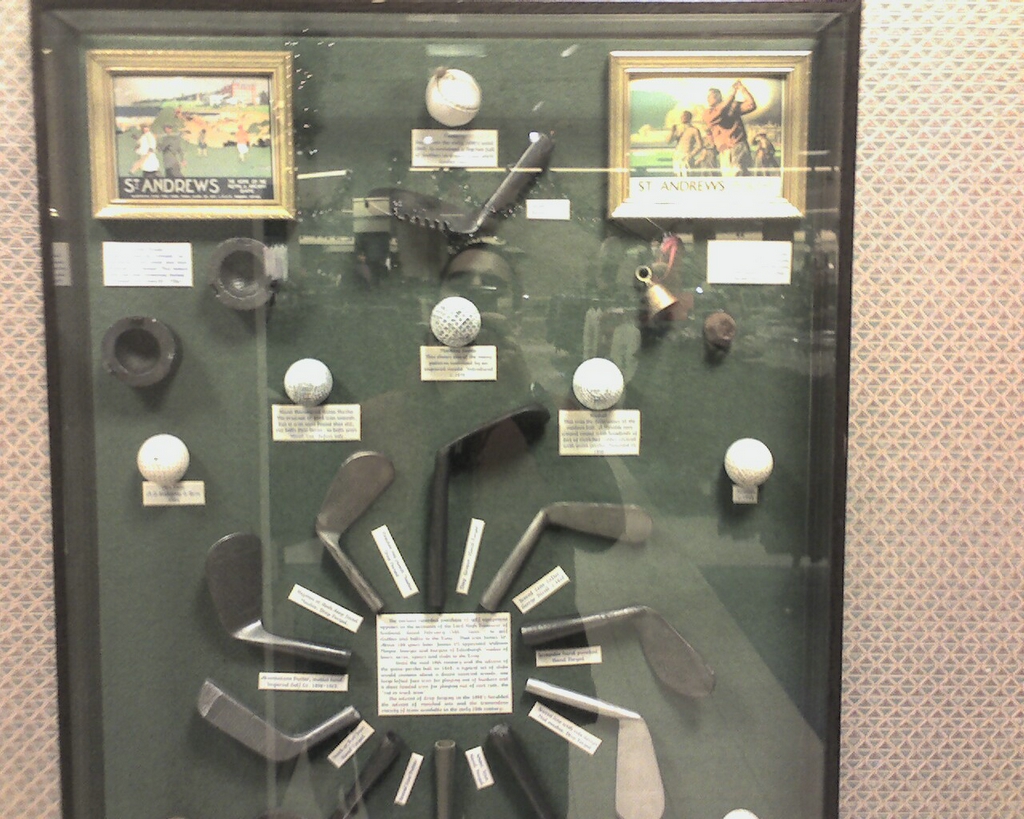
Tucked away in a hall that leads to a men's room in Von Maur, there's a nifty glass fronted mounted on the wall that contains some old golf artifacts. The club head on top caught my eye. It is aptly described as a "Combed Niblick." The golf ball right on top of it is also pretty curious- it has feathers flaring out of it.
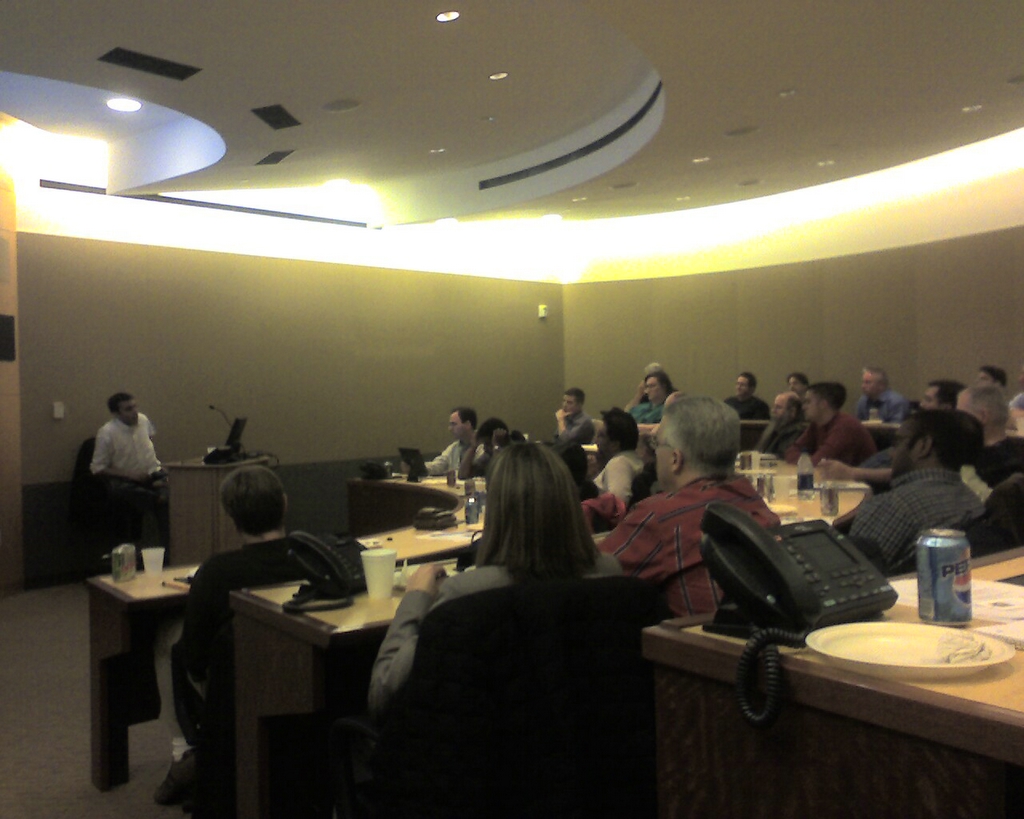
Vishal flew into town last week, armed with a presentation on Jini and JavaSpaces. He presented to the OJUG. I think we had the largest turnout since I've started attending the sessions. Vishal's presenting style was novel- not quite presentation zen, but engaging and fun nevertheless.

A trip to Whole Foods on a Saturday night had me staring at the vegetables organized so perfectly in the refrigerated section.

Driving down Dodge St, by the Mexican Consulate, there was quite a ruckus. People were walking around with banners, yelling about immigration, wall building, and the usual rhetoric that accompanies the subject. In the midst of all of this pandemonium, isolated from everyone else, was this woman. Her sign read, "Safe, Sane, LEGAL Immigration. It's the LAW." I rolled down my window, smiled at her and took her picture as she was waving at me.

No more baby teeth for Leela.
Subscribe to:
Posts (Atom)